
History of the Local Red Cross
This article is from the 2013 edition of the RCHS Spring Newsletter. RCHS is working to share more of our content digitally.

America’s entrance into World War I in early April 1917 prompted Rice County citizens to help the war effort by supporting the American Red Cross and its programs to aid soldiers. That movement led to the creation of local Red Cross chapters which evolved into today’s vibrant 86-year-old organization – the LeSueur-Rice-Waseca County Red Cross Chapter. Volunteers from the chapter are first on the scene when local disasters occur. They also organize local blood drives, offer safety training courses and swim lessons, help military families, and support efforts to help when state, national and international natural disaster occur.
Nationwide, the Red Cross grew from 107 chapters in 1914 to 3,864 chapters in 1918 because of a surge in patriotism to help American soldiers in France. The Red Cross also recruited 20,000 nurses to serve the American military during this era. Today, the American Red Cross has 600 chapters nationwide.
Clara Barton founder

The American Red Cross movement came about because of Clara Barton, a Civil War nurse from New England. After the war she lobbied for government support of the Geneva Convention, a treaty between nations to guarantee protection of wounded soldiers in war. She also lobbied for the government’s endorsement of an American Red Cross society similar to the international Red Cross movement founded by Henry Dunant of Switzerland.
The United States signed the Geneva Convention treaty because of Barton’s lobbying, and in March 1882, gave approval to form the American Association of Red Cross.
Barton set the stage for the Red Cross to help with national disasters and to train nurses and other volunteers with life-saving techniques. Early efforts included feeding stations and barracks erected on the flood-scarred landscape of Johnstown in 1889. As a result, the Red Cross banner became a familiar sight when natural disasters occurred. Distributing food and clothing following the Sea Island and Galveston hurricanes of 1892 and 1900.
Barton’s organization headed the Red Cross towards being the dependable “first-on-the-scene after a disaster” relief group it has expanded into today.
Long history of service
Faribault Chapter
On April 5, 1917, the Equal Suffrage Association in Faribault voted to support the Red Cross in response to President Woodrow Wilson’s appeal to Americans to help the war efforts. They made sterile surgical dressings, hospital liens and knit socks and other clothing for soldiers. It was not until Nov. 22, 1919 that Faribault volunteers officially renamed its group to the Rice County Red Cross and received a charter from the National American Red Cross.

A Faribault health committee gave assistance to help those suffering from the Spanish flu in 1918 and gave $1,000 in 1920 towards hiring a public health nurse to work with school children in the county. They started swim lessons and water safety classes beginning in 1928, contributed aid annually to house fire victims and also provided aid for state and local tornado victims. In 1933, Red Cross chapters across the country helped people suffering the economic effects of the Great Depression and in need of food.
During World War II, the Faribault Chapter helped military families. When the Cold War hit and atomic bombing became a threat in the 1950s, they helped with local civil defense preparedness. A Junior Red Cross was also started in the 1950s. Its members were local schoolchildren who would raise money to annually fill a handmade wooden chest with health and school supplies, musical instruments, athletic equipment and other items to be sent to the National Red Cross in Washington, D.C. The chests from Junior Red Cross members were sent to European nations recovering from World War II or other countries with schools in need.
During the 1950s, the Rice County Red Cross also had a Home Service Program that assisted local families financially when they faced family emergencies. Volunteer Red Cross nurses helped with blood collections, first aid instruction, polio shots and even helped train the first nurse’s aides in the county when a nurse shortage occurred in the late 1950s.
Northfield Chapter


People supporting the creation of a Northfield chapter of the American Red Cross met on April 24, 1917. In July, the Northfield chapter of the American Red Cross received a charter.
Northfield Red Cross activity in 1918 included: 67,477 surgical dressings, 11,509 knit clothes for soldiers, 916 articles of linen for French hospitals, all sent abroad; training 167 volunteers in first aid and 65 people in elementary hygiene. A total of $16,681.53 was raised by Northfield Red Cross chapter that year to support its activities.
Today
In 1988, the Northfield Red Cross merged with the Rice County Red Cross. In 1992, LeSueur and Rice Counties merged together with an office in Faribault. In 2011, the Waseca County chapter merged with the Rice-LeSueur chapter, although an official charter for the newly merged group is still being composed. Angela Storch, Executive Director of the new three-county chapter, has her office at 404 Central Ave. in Faribault.
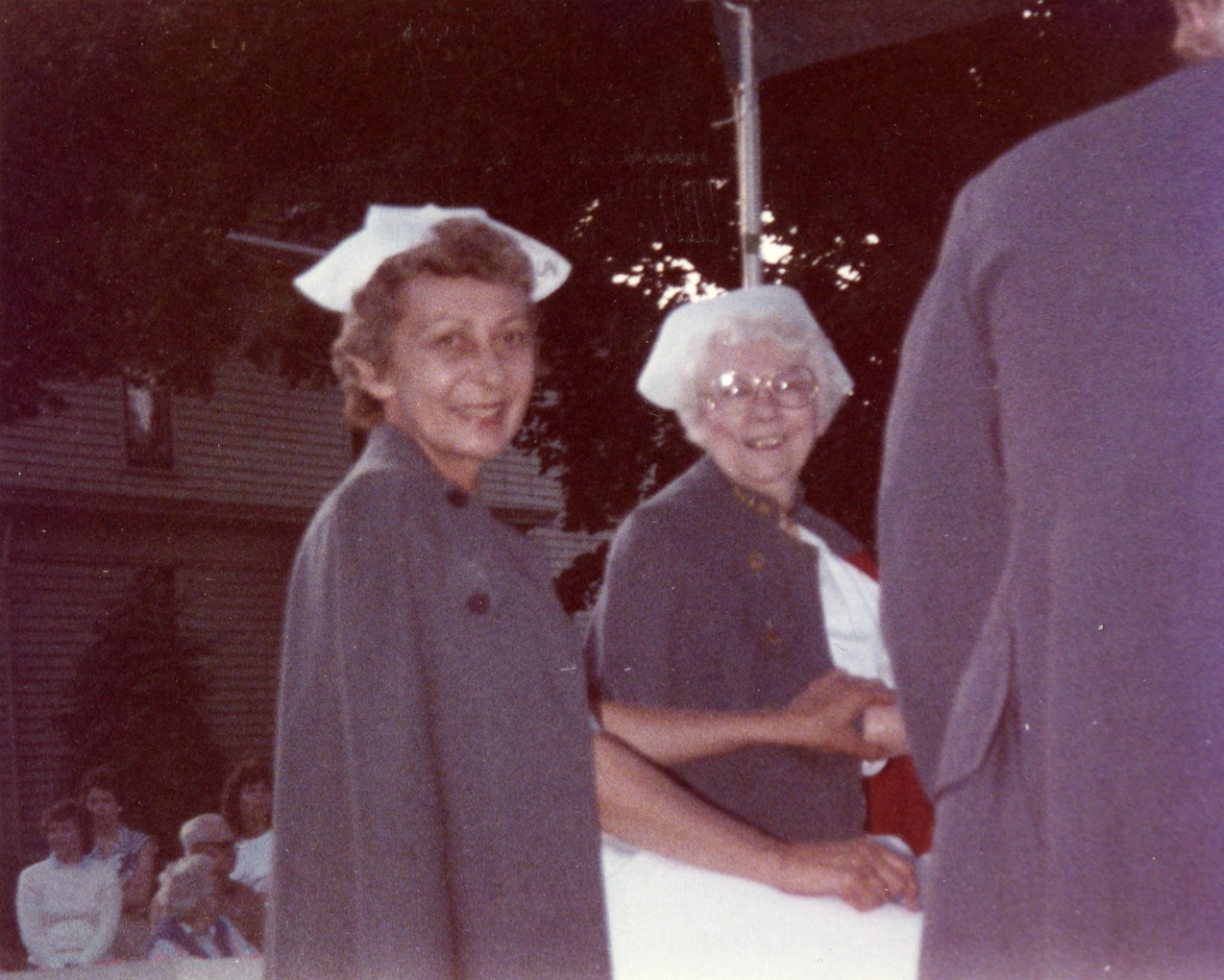

Today there are just eight Red Cross Chapters in Southern Minnesota, and the local three-county chapter is one of the largest, with over 100 volunteers, over half of whom are volunteers on its Disaster Action Team. It serves close to 120,000 people located over 1,500 square miles.
Volunteers Make it All Possible
When Judy Blackmer, who served as the local chapter’s Executive Director for 21 years from 1985 until 2006, first started, there were just two local Red Cross volunteers who would go to scenes of house fires to help victims. With so few volunteers, she would also go as an official to fire scenes. Her husband Jack didn’t want her to go alone, so went with her and soon became a disaster volunteer himself, eventually serving as chairman of the disaster committee for over 15 years.
Today there are 70 volunteers on the Local Disaster Action Team who help in various ways, from office work to being on an on-call rotation for local disasters, Storch said. Some volunteers are even trained to meet the qualifications to be deployed to a scene of a national or international disaster. She thinks the local chapter sending 10 disaster volunteers to aid victims of Hurricane Sandy is a sign that the local chapter is healthy and moving in the right direction.
Storch, whose position is part-time, is the only paid staff of the local chapter. A few days a week a regional Red Cross staff worker comes to Faribault to help with bookkeeping and data processing. “The Red Cross could not do all that it does without volunteers,” Storch said.
Nurses played prominent role
Registered nurse Nancy Baldwin of Lonsdale has been a volunteer for the local Red Cross chapter for 36 years.
Part of Baldwin’s job with the local Red Cross is to assess the health of local Red Cross disaster volunteers before they deploy to a major disaster site to assure they are healthy enough to do the jobs required.
“It used to be that we might deploy one or two disaster volunteers to a major national disaster site,” Baldwin said. “With Hurricane Sandy, we sent 10 volunteers because of the number trained and willing to volunteer.”
Blood collection and life-saving efforts
Besides volunteers, the Red Cross has always been dependent upon donations of money from citizens to support its disaster services and safety training programs, and for the donations of blood, bone marrow and organ donations for its life-saving efforts coordinated with national health organizations.
Recruitment of blood donors by the national Red Cross began in the 1930s. However, it took World War II and the need for blood to help wounded soldiers that led to the advent of the nation’s first blood-banking program by the Red Cross.
Countless newspaper clippings in the scrapbooks of the local Red Cross’ archives tell of blood drives starting from the 1940s and extending to the present, all around Rice County. The Red Cross is still a leader in blood collection with its bloodmobiles, which visit local communities around the country and collect blood from volunteer blood donors.
The late Rita Orr of Faribault, a pilot and member of the Minnesota Chapter of 99’s, an international organization of women pilots, flew blood in the 1970s between Faribault and the St. Paul Red Cross Blood Center. Advances in procedures to separate blood into components have eliminated the need for such flights. However, a Red Cross volunteer pilot might still fly life-saving tissue from one location to another.
Baldwin’s daughter came down with deadly leukemia when she was young and needed bone marrow. The Red Cross was managing a registry of donors at that time. Her daughter’s donor was a Red Cross volunteer. The Atlanta Red Cross also sent one of its paid staff to accompany the marrow to St. Paul.
“[Meeting the staff member] was memorable and I think of that meeting so often,” Baldwin said. At the time, families receiving organ and tissue donations were not permitted contact with donors. “This Red Cross worker became an important man because it put a face on the whole process.” Today, her daughter is healthy and married with a daughter of her own and has been a Red Cross volunteer for 10 years with her local chapter.
“At the time my daughter got sick, there were only 20,000 people on the bone marrow registry,” Baldwin said. “Today there are more than 30 million.” She credits the Red Cross and other groups championing the cause of organ donation for making that happen.
Many long-term volunteers
Baldwin, in her 36 years as a volunteer nurse with the local Red Cross chapter, has taught CPR classes, helped with bloodmobiles and served as a disaster and staff wellness nurse, been a member of the chapter’s board of directors and is currently a member of the disaster committee. She is just one of many who served as local volunteers for multiple decades.
The late Louise (Markowitz) Ames of Faribault is a prime example of long-term dedication. She died in 2005 at the age of 94. A July 12, 1987 article in the Faribault Daily News tells of her starting as a Red Cross volunteer in 1942. She served as executive secretary for many years. She touched many county families during the Vietnam War era through her administration of the “Service to Military Families” program, and by organizing summer swimming lessons for children and blood drives within the county. She was an Honorary Life Member of the Rice Red Cross Board of Directors when she died.
Blackmer believes many people are long-term volunteers because anyone giving their time to the Red Cross soon learns doing so helps people in a direct way.
“The 21 years I was executive director of the local chapter I found it the most worthwhile job I ever had,” Blackmer said. “It gave me a chance to offer a real contribution to help people. I was very fortunate.”
– Pauline Schreiber, RCHS volunteer