
Wish Walls for America’s 250th
This post was written by Ruby Mathiason and Lucy Watson, Carleton College students in HIST 216: History Beyond the Walls, Spring 2026. Thank you for all the hard work by the HIST 216 class and Dr. Serena Zabin to make this project possible!
Project Origin and Goals
2026 marks the semiquincentennial of the United States. To encourage civic engagement around this anniversary, Made By Us spearheaded a nationwide public history project inviting communities to reflect on what they wish for the future of the nation. The project involves installing “Wish Walls” in public spaces, which collect and display peoples’ wishes, sparking dialogue about the future we want to build together. Many locations across the country, including the Smithsonian, have hosted Wish Walls.
In the winter of 2026, the Rice County Historical Society (RCHS) and Carleton College partnered to bring Wish Walls to communities across Rice County, Minnesota. This collaboration was born out of a long-term partnership between these two institutions. Through this project, RCHS hoped to engage the Rice County community in the 250th anniversary, as well as appeal to younger generations. Carleton history students hoped to gain hands-on experience with planning and executing a public history project.
In approaching this work, team members considered historical approaches to U.S. national anniversaries, ranging from commemoration to celebration. We liked the open-ended model of the Wish Walls, which invite community members to share however they are feeling about the nation at the time. We hoped to capture how the community connected past and present values at America’s 250th, as well as hopes for the future. We hoped that these installations would create space for self-expression throughout the Rice County community in a fractured political world.
Project Activities, Team, and Participants
This project took place through Carleton professor Serena Zabin’s public history class HIST 216: History Beyond the Walls. The course had five students, representing a variety of class years and areas of study. In this course, students read fundamental public history texts and explored broader themes of the field while conducting the Wish Walls project. We worked in collaboration with RCHS staff, especially Kiran Loewenstein, RCHS Education and Outreach Coordinator, in conducting the project across Rice County, and in creating social media materials following the installation period. Throughout this process, we were also supported by the Carleton Center for Community and Civic Engagement.
RCHS partnered with a range of community locations across Rice County. The locations represented several different towns, age demographics, political cultures, and population sizes. Wish Walls were installed at the following locations:
| Site | Address | Description |
| Carleton College | 300 N College St., Northfield, MN 55057 | Liberal Arts College |
| Northfield Union of Youth (The Key) | 109 6th St. W, Northfield, MN 55057 | Youth community center |
| Northfield Public Library | 210 Washington St., Northfield, MN 55057 | Public library, high patronage of families |
| FiftyNorth | 1651 Jefferson Pkwy, Northfield, MN 55057 | Senior center for folks aged 50+ |
| Buckham Memorial Library | 11 Division St. E, Faribault, MN 55021 | Public library, medium patronage |
| Buckham West | 19 Division St. W. Faribault, MN 55021 | Senior center for folks aged 50+ |
| The Oasis | 212 Central Ave N, Faribault, MN 55021 | Smoothie shop |
| Lonsdale Public Library | 1006 NE Birch St, Lonsdale, MN 55046 | Public library, very low patronage |
Geographic Distribution of Sites

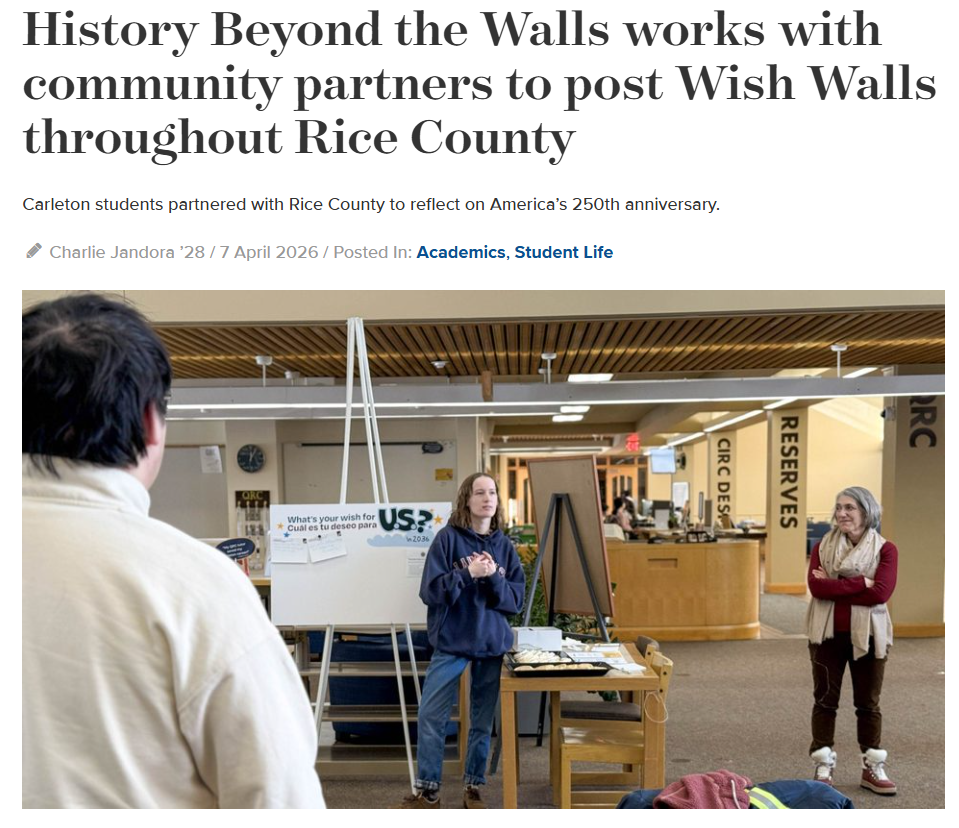
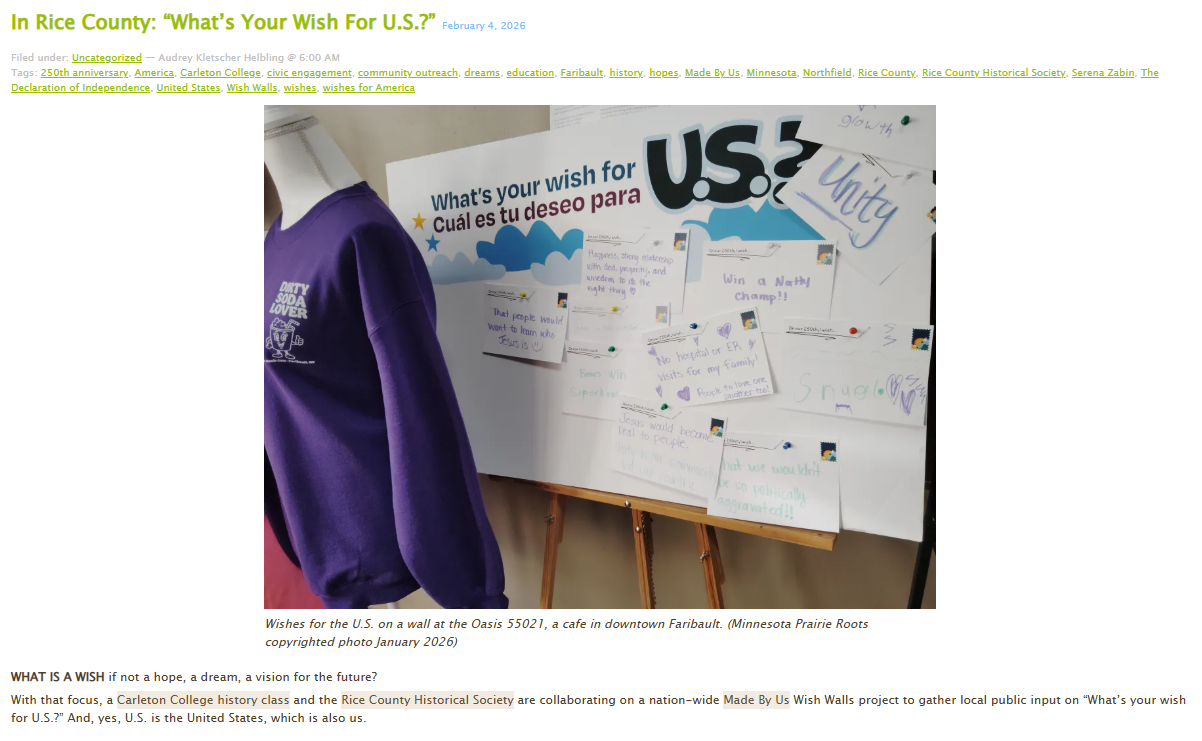
Wish Walls were installed at the various sites using digital materials from Made By Us. The basic set-up included a posterboard, notecards, and a collection box. Participants were asked to write a wish they had for the U.S. on its 250th anniversary, and then drop it in the box. At locations that were willing or able, we hosted a small launch event to kickstart participation in the project. During weekly checks, students and RCHS staff pinned completed cards onto the board. The installation period was roughly 6 weeks, with boards going up in early January and coming down mid-February.
Due to its larger size, the installation at Gould Library had three boards, and uniquely asked participants for their wishes for the U.S. in 2036, 2076, and 2126. In addition to this installation, students distributed and collected cards from a range of campus offices to increase faculty participation.
Challenges and Lessons Learned
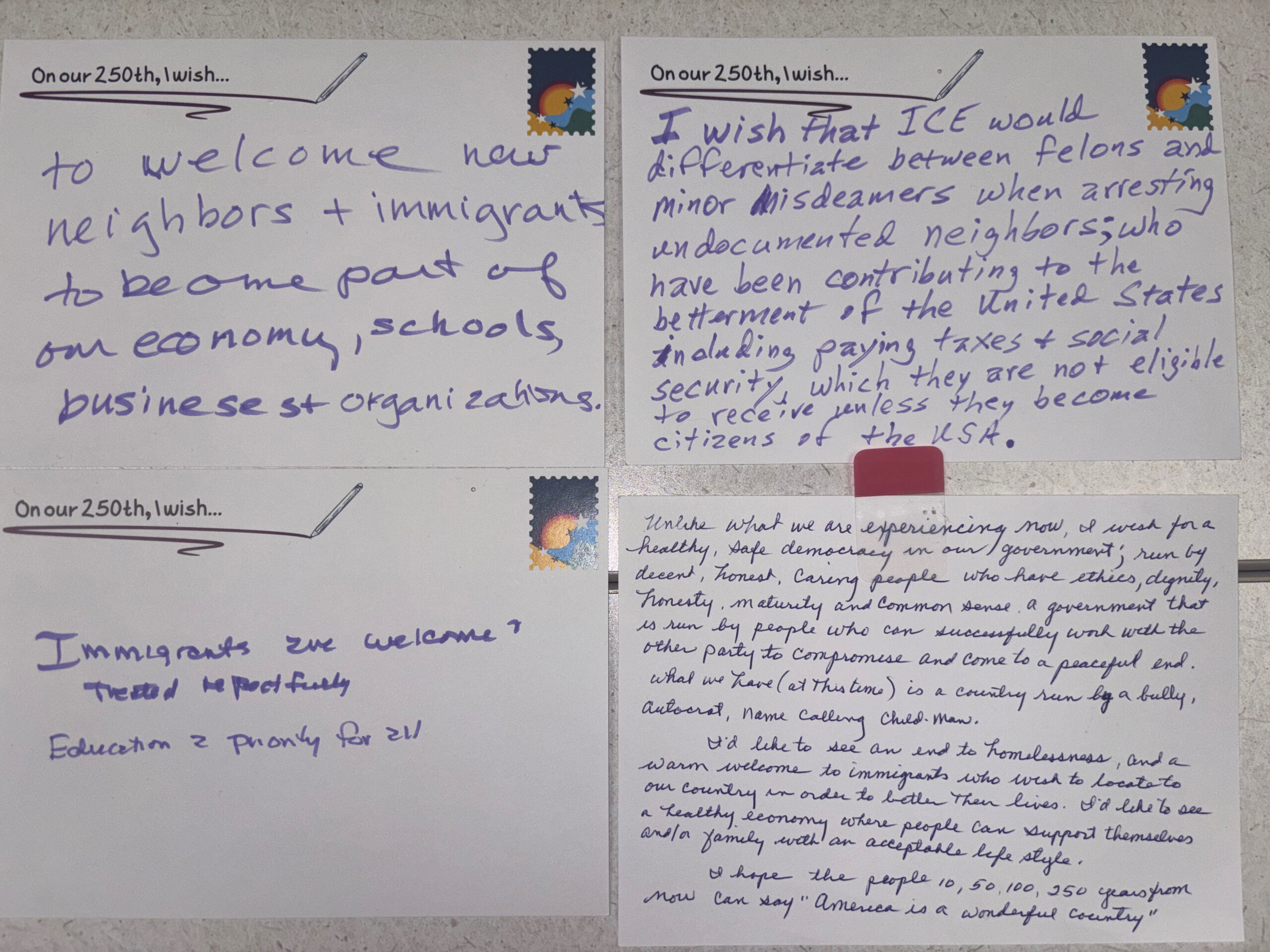

One notable challenge of the project came from the political climate it was conducted in. During Week One of the project, Renee Good was killed by an Immigration and Customs Enforcement (ICE) officer during Donald Trump’s Operation Metro Surge, an operation targeting Minnesota for immigration enforcement. The overall state climate was divided and chaotic following Good’s death and the continuation of Operation Metro Surge. Carleton’s campus was locked down following ICE presence close to the campus. This made all project participants more eager and nervous for the viewpoints expressed in the cards, especially given the history of tension between Faribault and Northfield. We discussed how political discourse can play out in public history.
Another challenge was the size of the team. With only five students in the class, our groups was very small. The main challenge this posed was with speed and efficiency of work, with fewer students amongst whom to divide up tasks. The size of the team, the limitations of being college students, and the schedule of the course made it somewhat difficult to communicate with sites—Professor Zabin was our main point of contact between the students and sites. It should be noted that this project spanned a large physical space. Polling a rural Minnesotan county was no easy task!
Two other challenges came from promotion and expectations for engagement with the project. If we were to do the project again, we would create more promotional materials to drive engagement. Aside from our “launch events,” which we gradually standardized and became more accustomed to, we could have done more outreach to encourage participation in all sites. The other main challenge was related to directions for the project—some participants took cards home, or wrote on the boards instead of the cards. Notably, Buckham West reported spirited conversations happening that translated into more vague or neutral cards than the conversation would have indicated. This also may have occurred at other sites. We identified that cards may have been more overtly political at Northfield Public Library because of the anonymity one has when visiting the Library as opposed to the senior center. Identifying how to embolden participants and communities to share their real opinions is an opportunity for future efforts.
Outcomes
In total, 245 Wish Wall cards were collected from the project. The below graph represents where cards were sourced from, with the majority being from Carleton College. This is likely because of easier access to Carleton respondents, resulting in easier communication with respondents and promotion of the project.
The fewest number of cards were collected from Lonsdale Library, due to low patronage and promotion of the project. However, the librarians at Lonsdale expressed gratitude at being part of the project. The number of cards collected is secondary to the experience of participating in a public history project as an institution, and so the low turnout at sites like Lonsdale and Faribault libraries should not discount them from future involvement. If anything, it should motivate us more to include underrepresented groups in public history projects in the future, regardless of past participation rates.
After collecting the cards, we analyzed common themes arising from the responses. Some of these themes included (but were not limited to) “Return To Past,” which encompassed elements like the Constitution, Founding Fathers, and Democracy; “Unity;” “Current Events;” and “Public Policy,” which included mostly Healthcare-related wishes. Using these themes and our research into 1876, we created two different types of Instagram content to be showcased on RCHS’ page.
The first type is called “Thematic” content, which showcase cards as groups of themes without historical commentary. These posts were tackled by a smaller team of three students while the other two worked on this project documentation. The goal of these posts were to show the public what we collected during the Wish Wall project.
The second type were the “Past and Present” Reels. These directly incorporated our historical research, using the primary sources of the past as voices in conversation with the wishes we gathered. Each member of our team wrote a script for a Past and Present Reel with feedback from Professor Zabin and the whole group. The five themes for these Reels were Commemoration, Environment, Community Life, Jokes, and Immigration. These themes were decided based on a synthesis of Themes from the cards and relevant research conducted earlier in the term. Using these scripts, we filmed more traditional short-form-style Reels blending education and entertainment.
Dissemination and Future Access
The posts and reels were shared with RCHS. The hope is that these social media posts will promote the project and RCHS as an institution. These Reels can also be shared and cross-posted by other partners in the project, such as Carleton College, the college’s Gould Library, and the college’s Center for Community and Civic Engagement.
The cards, alongside the project documentation and some other materials from the project that provide context, will be held in the RCHS archive. Our desired outcome is that Rice County citizens of the future will have access to this project and its findings in 2076, 2126, or any other time they see fit to reflect on the past and future of the nation.
Project Continuation and Long-Term Impact
With this project, we want to make sure RCHS has enough resources to do what they wish with the Wish Wall content. As RCHS will have access to the Wish Wall cards, they can choose to display them in an exhibit, either during the 4th of July/Rice County Fair festivities, or at any point in the future. RCHS will also set up a Wish Wall during the County Fair, which draws roughly 2,000 people to the RCHS each year. We have also discussed having student volunteers help with accessioning the cards, a repetitive task necessary to officially add the cards to the RCHS archive. This is because we want to lessen the workload for RCHS and see the project all the way through to the end.
We hope to foster a strong working relationship between the RCHS and Carleton so that we can continue to partner together on public history work. This project will hopefully create a framework for future students and professors to build on to create smooth, successful collaborative projects in the future.