




The Lake Mazaska Serpent: A Shieldsville Legend
March is National Irish‑American Heritage Month, which makes it a fitting time to revisit one of Minnesota’s most persistent pieces of late‑19th‑century lore—the Shieldsville Serpent. For 150 years, this mysterious creature has surfaced in newspapers, tavern talk, and the imaginations of those living near Lake Mazaska, long tied to the Irish community of Shieldsville in Rice County. What began as a curious sighting in the 1870s soon grew into a legend with remarkable staying power.
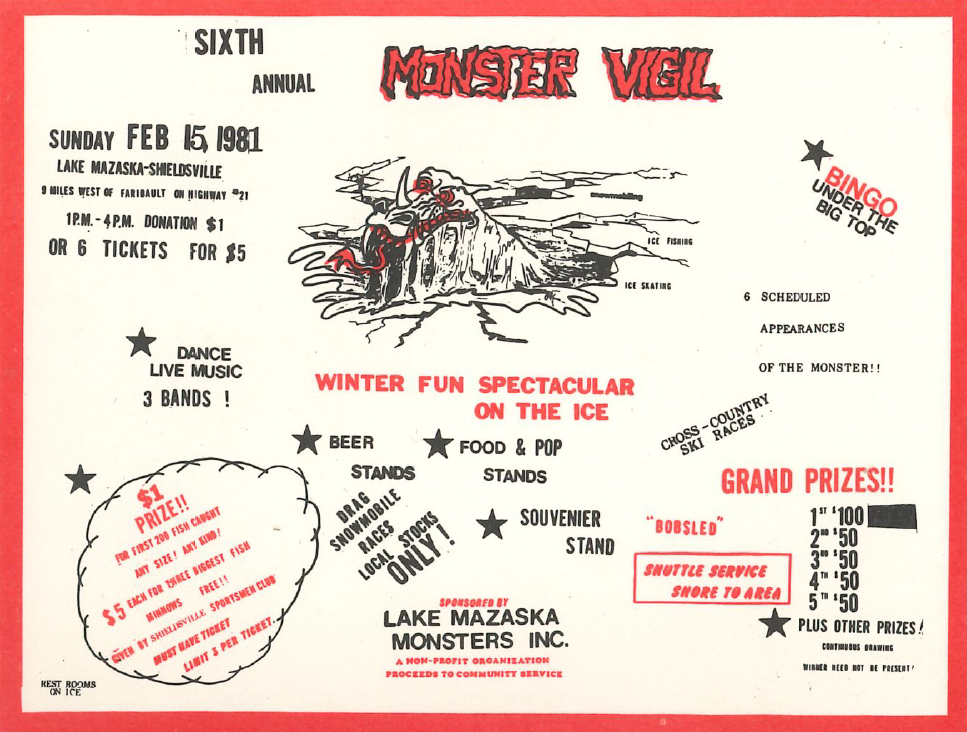
Advertisement for the 6th annual Monster Vigil in 1981.
1875: A Sensation Is Born
The first spark came in August 1875, when the Faribault Republican announced that Shieldsville had “a sensation in the shape of an aquatic monster.” No one could quite decide what it was—“sea‑serpent, devil‑fish, alligator or sturgeon or some monster yet new to naturalists.”
Read the original Faribault Republican article here:
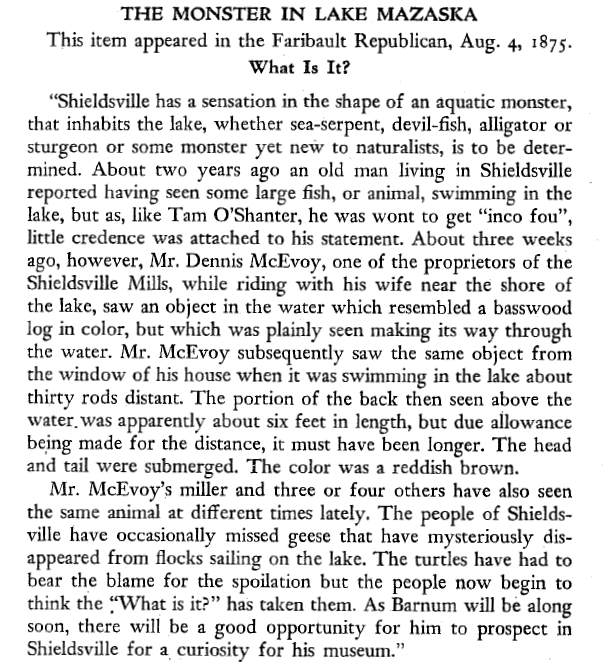
An elderly resident had claimed two years earlier to have seen a large creature in the lake, but, as the paper hinted, he was sometimes under the influence, and few believed him. That changed when Dennis McEvoy, co‑owner of the Shieldsville Mills, and his wife spotted something reddish‑brown moving through the water “like a basswood log,” except unmistakably alive.
Missing ducks and geese were soon blamed on the visitor, and the paper joked that P. T. Barnum might want to stop by Shieldsville to “prospect” for a new museum curiosity. A legend, once seeded, rarely stays small.
1886: The Monster Grows More Fantastic
By August 1886, the serpent had grown in both size and spectacle. The St. Paul Pioneer Press reported that a party of respectable Rice County anglers watched a “horrible‑looking monster” glide across Lake Mazaska for nearly twenty minutes. They described bright, glistening scales and a creature “not less than thirty feet” long—details that gave the story new color and credibility.
Less than two weeks later, the St. Paul Daily Globe published an even more elaborate eyewitness account from an unnamed Faribault “special correspondent,” describing the experience of a Mr. Ellsworth, a highly regarded missionary and businessman—though almost certainly a creation of the reporter’s imagination. Driving along the lake in a buggy, Ellsworth first took a distant shape for an overturned boat. But as he watched, he became convinced it was alive—“about thirty feet long,” with a head of “gigantic proportions” and two straight horns rising above its eyes. Its scales, he said, shimmered from yellow to blue to green as it moved.
Then came the flourish only folklore can supply: as it neared shore, the creature “got up on its hind feet and walked out into the road,” tossing its tail over its shoulder like a fan. Its mouth displayed a “royal flush of teeth.” Ellsworth added that the strangest thing about the monster was that “you never see it until after you have been to Shieldsville.”
The New Ulm Weekly Review couldn’t resist. “It’s a poor community that can’t have a sea serpent nowadays,” the paper quipped, repeating the thirty‑foot description and shimmering scales before adding a jab: “Something must be wrong with the liquor people drink these days.”
1890s and Beyond
By the early 1890s, the serpent had become a familiar headline. Another New Ulm newspaper clipping described a “queer‑looking animal” near a Shieldsville stream—cigar‑shaped, brown, and twenty‑five to thirty feet long. The witness saw it only briefly before it slipped away, though the paper noted that a similar creature had been reported three years earlier. By 1893, even the Northfield News joined in, recounting a tale of the serpent rising from the lake with “flames shooting from his mouth.”
The legend lingered well into the 20th century. In 1940, the local history Meet Shieldsville: The Story of St. Patrick’s Parish, Shieldsville, Minnesota observed that “there are people to this day who believe that story,” noting that the serpent was still said to raise “its weird head” from time to time. Some described it as sixty feet long, “with a body like a camel and a little round head”—an image so peculiar it only strengthened the creature’s hold on local lore.
Monster Days, Shaksa, and the Staying Power of a Legend
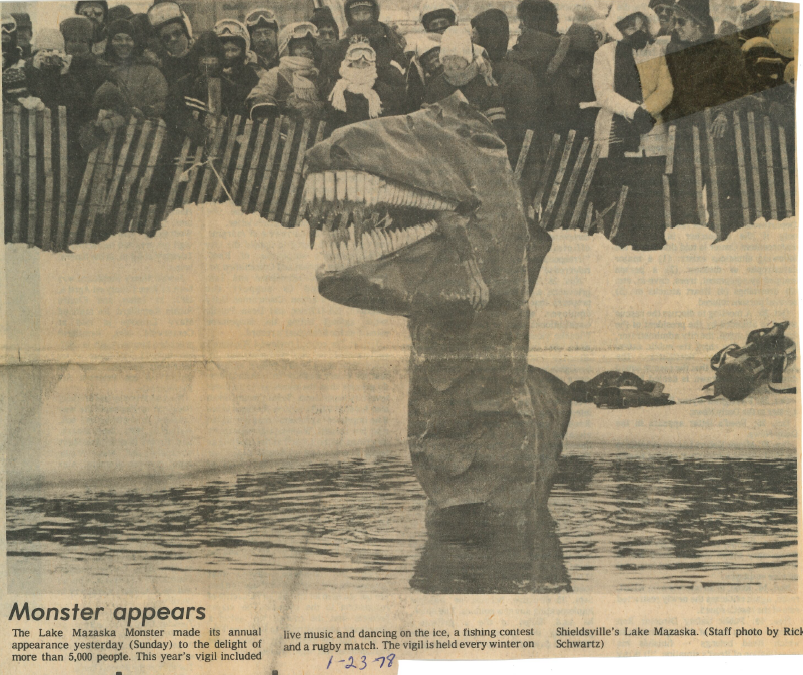
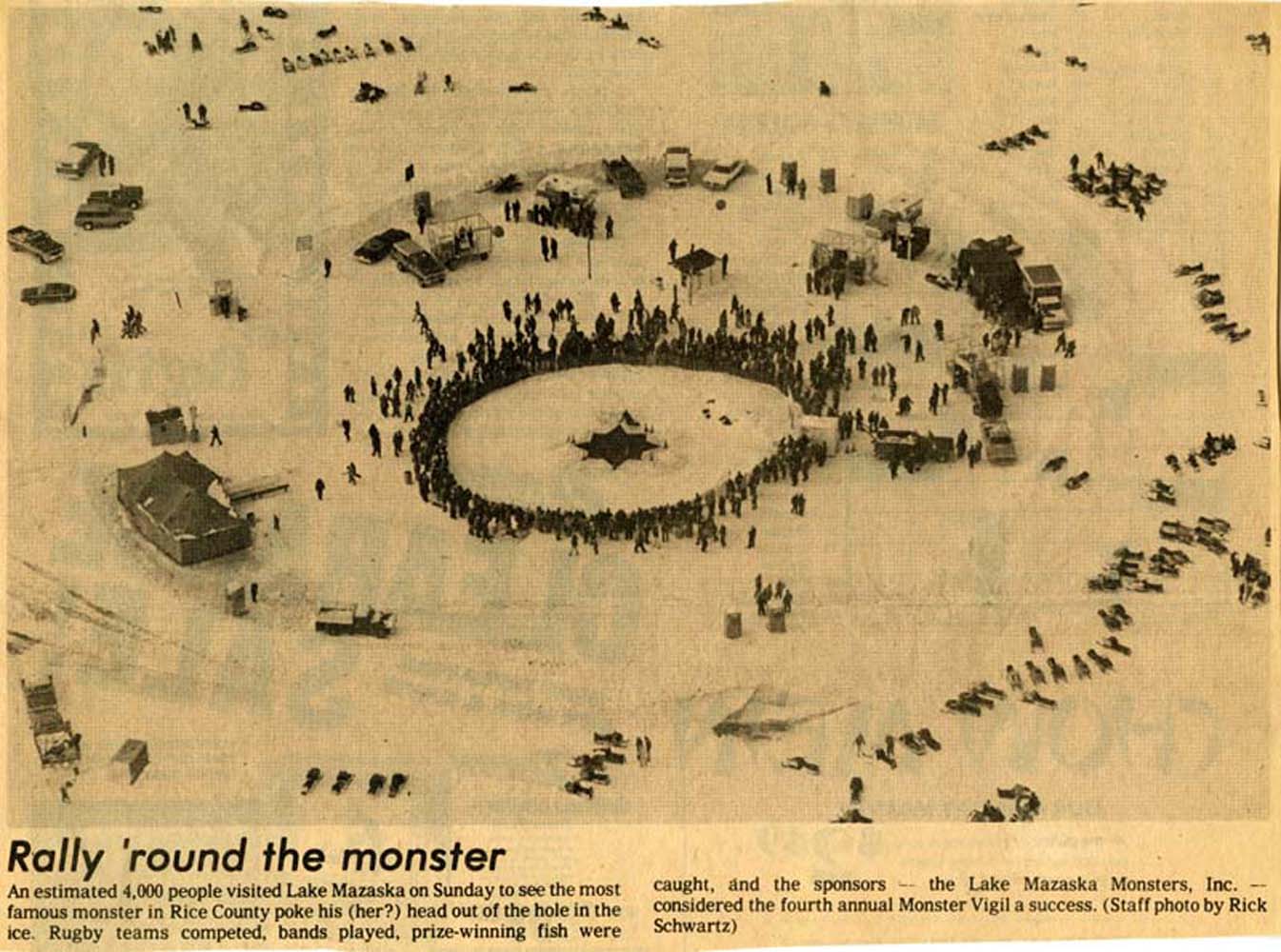
The serpent resurfaced in 1976 when Shieldsville launched its first annual Monster Vigil—fondly remembered as Monster Days—and unveiled a handmade creature nicknamed Shaksa, staged to rise dramatically from a hole in the ice. The Northfield Fire and Rescue Department assisted in the production, including placing the monster beneath the ice.
The Monster Vigil weekends of the 1970s were lively affairs: monster appearances, dance bands, bingo, an ice‑fishing contest, food concessions, skating, and snowmobiling all helped turn the winter gathering into a full‑blown community celebration. The tradition was short‑lived but unforgettable, cementing the monster’s place in local lore. Decades later, in 2016, a children’s book—Lake Mazaska Monster by Carol VanSickle—softened the creature’s image for a new generation.
The Shieldsville Serpent endures not because anyone ever proved it existed, but because the stories were simply too good to let go. A curious ripple became a creature, and a creature became a tradition that locals still smile about.
And really, why cross an ocean to Scotland in search of Nessie when you can drive to Shieldsville? Watch Lake Mazaska at dusk, and you might just see something move—maybe even a hint of Shaksa stretching after a long winter’s nap.
Watch KTSP’s coverage of the Lake Mazaska Monster here!
—Jeff Sauve, Northfield